If you’re pushing into Hell-level difficulty, climbing competitive ladders, or refining your multiplayer tactics, you’re not here for surface-level tips. You want sharper mechanics, smarter strategies, and a real edge where it counts. This article is built for that exact purpose.
We break down core mechanics that separate casual play from high-level execution, uncover campaign strategies that translate into measurable skill growth, and analyze multiplayer tactics that consistently outperform standard meta picks. For competitive players, we also examine esports performance metrics to show how precision, efficiency, and decision-making speed directly impact results under pressure.
Every insight is grounded in deep gameplay analysis, high-level match breakdowns, and proven optimization frameworks used in serious competitive environments. Whether you’re refining micro-decisions or overhauling your entire strategic approach, you’ll find clear, actionable guidance designed to elevate your play immediately.
If your goal is mastery—not just participation—you’re in the right place.
Beyond the Scoreboard
Tired of grinding ranked only to see your badge barely move? You are not alone. Win/loss records feel like the whole story, but they hide the leaks. Maybe your aim cracks under pressure, or your map awareness drops after ten minutes. That is where esports performance metrics change everything. Track damage per round, objective control time, and unforced errors. Elite players obsess over patterns, not vibes. Review replays, log mistakes, and set one focused goal each week. Yes, it is tedious. But guessing is worse. Measure what hurts, then train it. Progress becomes visible, and rank follows.
The Universal Language of Performance: Core Esports Metrics
Why These Numbers Actually Matter
If you want measurable improvement—not just vibes—understanding esports performance metrics changes everything.
KDA Ratio (Kills/Deaths/Assists) is often treated like a scoreboard trophy. But it’s really a positioning report card. A “good” KDA might mean you played safely and avoided deaths. An impactful KDA means your eliminations led to objectives, map control, or round wins. For example, a 5/1/2 support who secures vision and survives key fights may contribute more than a flashy 12/8/3 fragger. The benefit? You stop chasing stats and start chasing wins.
APM (Actions Per Minute) sounds impressive—until you realize spam-clicking inflates it. What matters is effective APM: deliberate inputs that create advantage. Think of a StarCraft pro executing precise build orders versus someone frantically mashing keys (quantity vs. quality). Tracking mechanical efficiency helps you refine muscle memory and reduce wasted motion.
Win Rate & Consistency reveal patterns others miss. Break performance down by map, agent, or comp. Track results across 10, 20, and 50-game blocks. You’ll identify your comfort zones—and your blind spots.
The upside? Smarter practice, faster improvement, and confidence rooted in data—not guesswork.
Genre-Specific Analytics: First-Person Shooters (FPS)
I used to think I was “cracked.” Then I checked my stats.
After a rough weekend tournament, I pulled my match data and realized my headshot percentage was far lower than I’d imagined. That was my wake-up call. In FPS titles, tracking Accuracy Metrics: Headshot percentage, body shot percentage, and overall accuracy isn’t about ego—it’s about identifying mechanical gaps. I started using aim trainers to establish a baseline, running the same drills daily and logging tiny gains (sometimes as small as 1%). Those micro-improvements compound.
Economic Management (Tactical Shooters)
In tactical shooters, I learned the hard way that frag highlights don’t win championships—economy does. Average economy rating, cost per kill, and successful utility usage (like flash assists or properly layered smokes) often matter more than raw aim. There were matches where I top-fragged but mismanaged buys, forcing awkward half-purchases that snowballed into losses. Managing your team’s credits is as important as clicking heads (yes, even if your crosshair placement is chef’s kiss).
Pro tip: Track utility impact in scrims. If your flash doesn’t convert into space or kills, it’s just expensive fireworks.
Positional & Rotational Metrics
First blood/first death rate, average time to engage, and successful site retakes/holds reveal decision-making patterns. During VOD reviews, I noticed I over-rotated on early sound cues, leaving bombsites exposed. Mapping these mistakes visually changed everything.
If you’re serious about optimization, pair these esports performance metrics with a structured system like building a long term training routine for esports success. Stats tell you what’s wrong. Structure tells you how to fix it.
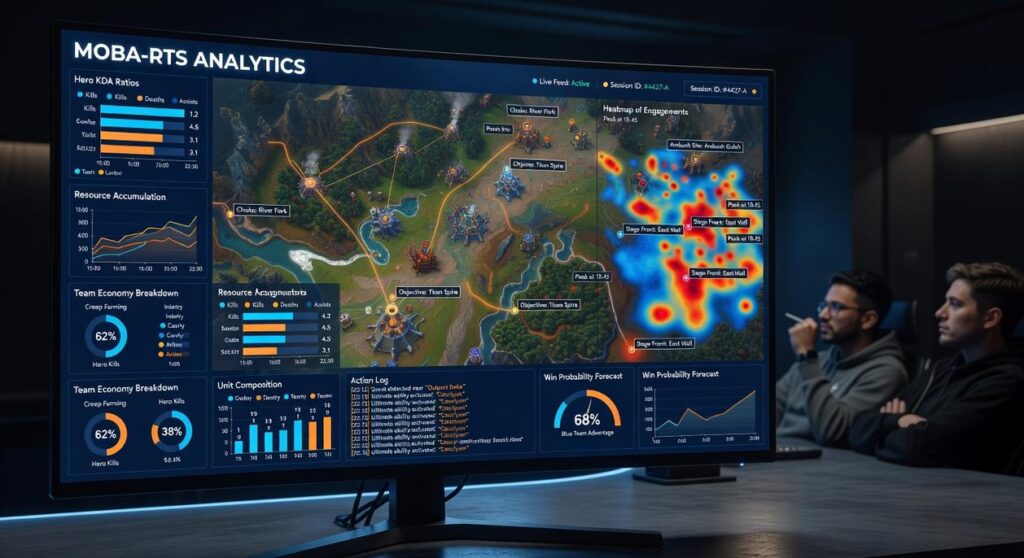
Genre-Specific Analytics: MOBA & RTS

I still remember reviewing a match where I felt unstoppable—top damage, flashy plays, highlight-reel material. We lost in 28 minutes. That was the first time I realized raw mechanics mean nothing without the right numbers behind them.
In MOBAs and RTS titles, resource management starts with GPM (Gold Per Minute) and XPM (Experience Per Minute). GPM measures how efficiently you convert map presence into gold income, while XPM tracks how quickly you level relative to game time. During laning, compare your averages to pro benchmarks to see if you’re farming efficiently under pressure. By mid-game, your GPM should reflect smart rotations, not just safe wave clearing (hiding under tower isn’t “macro”). Late-game, small dips can signal poor map access or vision denial.
Playing the Map, Not Just the Fight
Next comes objective control—damage to towers, inhibitors, dragons, or barons. These numbers reveal map impact. Add vision score (how effectively you place and clear vision) and crowd control score (how long you impair enemies), and you start seeing real esports performance metrics that correlate with wins. I once improved my win rate simply by tracking objective damage instead of obsessing over KDA.
Finally, analyze team fight participation: kill participation percentage, damage dealt to champions, and healing/shielding done. High damage with low participation? You’re arriving late. High participation but low output? You may be mispositioned. (Yes, I’ve been both.)
Numbers don’t replace instinct—but they sharpen it.
From Data to Dominance: Building Your Improvement Framework
You’ve got the numbers. Now what? Data without direction is just noise (and noisy players rarely climb). The key is a simple feedback loop: track, review, adjust, repeat. Focus on one priority metric at a time so your practice stays intentional.
For example, if esports performance metrics show low objective control, shift scrims toward timing drills and map rotations.
| Step | Action | Outcome |
|---|---|---|
| Track | Record one metric daily |
Clear baseline |
| Review | Analyze gameplay clips | Spot patterns |
| Adjust | Design targeted drills | Measurable gains |
Start with one metric this week. Depth beats scattershot effort—every time.
You came here to sharpen your edge—and now you have the mechanics, strategies, and tactical insights to compete at a higher level. From mastering core systems to refining multiplayer coordination and conquering hell-level challenges, you’re no longer guessing. You’re executing with intent.
The difference between average and elite play comes down to consistency, decision-making speed, and tracking the right esports performance metrics. If you ignore them, you stall. If you optimize them, you climb.
Now it’s time to act. Review your last matches. Identify one mechanical weakness and one strategic mistake. Queue up with a focused objective and measure the result. Improvement isn’t random—it’s engineered.
Take Control of Your Competitive Climb
If you’re tired of plateauing, start training with purpose. Focus on the systems that directly impact your esports performance metrics, refine your tactics, and pressure-test your strategy in real matches. Players who commit to structured optimization win more—period.
Stop playing casually. Start playing deliberately. Queue up, apply what you’ve learned, and turn your next session into measurable progress.
